IIED's best of 2024: publications
For the second year in a row, social protection, loss and damage and debt relief are the hot topics in IIED’s 10 most downloaded publications in the last 12 months. We published more than 100 publications, but the top downloads continue to be mostly on these themes.

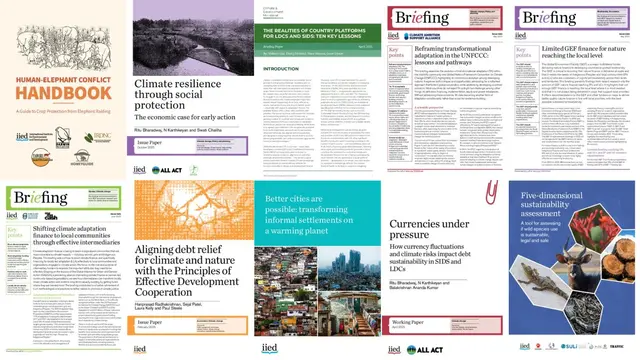
Covers of IIED's most downloaded publications of 2024 (Photo: IIED)
In 2024, the world has seen both progress and setbacks in mitigating climate change, preventing nature loss and getting money where it matters.
Through it all, IIED was creating research to provide evidence and to advocate for those communities most affected by the climate and nature crisis – from working with Small Island Developing States to create policies to get out of debt, to showing the crippling losses and damages from climate change faced by women, to launching a new manifesto setting out our ways of working.
Here are our top 10 most downloaded publications of 2024, plus one published in late 2023.
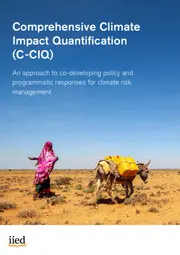
1. Comprehensive Climate Impact Quantification (C-CIQ): an approach to co-developing policy and programmatic responses for climate risk management
Across the world, climate impacts such as extreme heat and floods are destroying lives, livestock and property. Loss and damage occurs when the capacities of affected communities and countries are compromised to the extent that they can no longer absorb the effects of climate impacts or adapt to climate risks.
Climate-related loss and damage has consequences beyond the economic; these impacts are often referred to as non-economic loss and damage, such as the loss of cultural heritage. We urgently need to develop new ways to manage loss and damage risks, and to do this we need to understand and measure their full range. But current methodologies for understanding and measuring climate-related loss and damage have significant gaps.
This 99-page toolkit offers a comprehensive step-by-step guide to quantifying and valuing economic and non-economic loss and damage, and co-developing policy and programmatic responses to manage climate risks. We have sought to demystify complex analytical methods and make them straightforward, easy to understand and versatile enough to be applied in diverse geographic and social contexts.
More about this work: IIED has developed tools and approaches for existing social protection programmes to help communities better absorb the effects of climate risks, adapt to climate impacts and transform their capacities to address growing climate stresses. Together with partners we’re tackling climate change loss and damage by strengthening anticipatory risk response under social protection programmes.
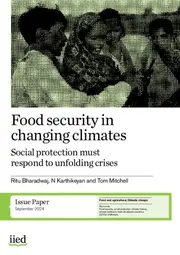
2. Food security in changing climates: social protection must respond to unfolding crises
Climate change is severely impacting the four pillars of food security: availability, accessibility, utilisation and stability. Ensuring food security amid escalating climate impacts therefore requires immediate and concerted efforts.
This 30-page issue paper discusses how social protection can become more ‘anticipatory’ and make food security more resilient to climate risks. It draws on analysis using the Anticipatory Social Protection Index for Resilience (ASPIRE) toolkit in eight countries: Bangladesh, Ethiopia, Ghana, India, Malawi, Pakistan, Senegal and Uganda.
Within each country, social protection policies, systems and three social protection programmes were evaluated. ASPIRE food security indices were developed representing the four pillars of food security. Based on this analysis, the paper then discusses how governments, funders, international organisations, the private sector, civil society and local communities can jointly strive to build resilient food systems for all.
More about this work: The ASPIRE diagnostic tool is designed to assess the readiness of a country's existing social protection programmes to deliver climate resilience. It helps assess a country's overarching social protection policies and systems, guided by 36 indicators that cover policy objectives, innovation, risk definitions, target specifications, planning and budgeting process, and types of assistance.
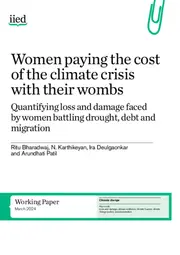
3. Women paying the cost of the climate crisis with their wombs: quantifying loss and damage faced by women battling drought, debt and migration
As climate change intensifies, it is imperative for policymakers to address the escalating loss and damage it inflicts on vulnerable communities in developing countries.
In India's Maharashtra state, these impacts are forcing rural families into life-altering decisions and migrations to work in sugarcane fields, where exploitative practices by contractors, including fines for work absences, are prevalent. The fear of losing income drives many women to have hysterectomies to avoid having to take breaks due to menstrual pain.
This 72-page working paper uses two frameworks to analyse and quantify the economic and non-economic loss and damage faced by these communities, offering insights into the multifaceted nature of climate impacts.
More about this work: Focusing on women in Beed, India, an online event in March showed how women are disproportionately affected by climate change. We examined the connections between climate-induced droughts and debt bondage, and the significant impacts on women's physical and mental health – leading to drastic health decisions. Watch the recording.
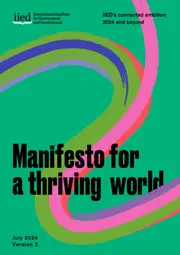
4. Manifesto for a thriving world: IIED’s connected ambition, 2024 and beyond
Following a year of review and dialogue, this manifesto presents IIED's refreshed approach to impact. This new approach to working on problems, in equitable learning partnerships, focuses on specific propositions to progress towards a thriving world.
We acknowledge that achieving our mission means we cannot continue doing more of the same and instead must challenge ourselves to take a bold new direction while retaining the best of what makes IIED unique. Rather than setting fixed targets and narrow objectives, with this manifesto we aim to be more responsive to climate change, social and economic shocks, and to be more agile.
This 24-page manifesto is the product of a collective effort of IIED staff, associates, trustees and friends based on 12 months of listening, conversations and co-designing. This is a live document and one we know will change based on the insights we generate, inputs from the community and the changing context we work in.
More about this work: In episode 27 of the Make Change Happen podcast, the chair of IIED's board of trustees Tara Shine, and trustee John Taylor talk about the ambitions of our manifesto and the need for new responses to a range of compounding crises, greater uncertainty and growing injustice.
5. Global Small Island Developing States Debt Sustainability Support Service: a new financial compact for resilient prosperity
Small Island Developing States (SIDS) are experiencing increasingly frequent climate-related disasters with severe consequent economic impacts. These nations’ financial stability is further compromised by escalating debt: more than 40% of SIDS are nearing or already in debt distress.
This 24-page document sets out the design for a Global SIDS Debt Sustainability Support Service, which will feature a layered approach to debt sustainability, future protection measures, resilience investment, and advisory and legal support. The support service is a central component of the Antigua and Barbuda Accord for SIDS (ABAS), a ten-year plan for delivering a resilient future for SIDS.
More about this work: SIDS are uniquely vulnerable to climate change impacts, particularly tropical storms, flooding, erosion and rising sea levels. As the intensity and unpredictability of these events increases, SIDS' growing climate vulnerability is compounded by inaccessible, opaque and inappropriate credit rating processes, which lead to higher borrowing costs and hinder the ability of SIDS to invest in resilience and sustainable development.
A working paper published in July suggests three ways to reform credit rating methodologies to ensure a fairer financial landscape for SIDS and to help foster a resilient, equitable future for these vulnerable nations.
6. Guide to climate negotiations terminology
Designed as a companion for government and non-government participants in the United Nations Framework Convention on Climate Change (UNFCCC) negotiators, this guide offers an in-depth look at the specialised terminology used, focusing on the key terms and expressions unique to the field of climate law.
Now in its second edition – published nearly a decade after the original – this updated 32-page guide builds on the foundation of its predecessor. It introduces new terms, buzzwords and expressions that have emerged since the adoption of the Paris Agreement in 2015, and incorporates fresh textual examples.
More about this work: IIED works with the Least Developed Countries Group to level the playing field for their engagement in the international climate change negotiations. Together with strategic partners, we organise training workshops, produce publications and provide direct support to delegates to strengthen their negotiating skills.
7. Loss and damage of nature and biodiversity: a tale of consumption, colonialism and communities
With biodiversity being lost at an unprecedented rate, the world faces a nature – as well as a climate – emergency.
Tracing the story behind loss and damage in ecosystems and biodiversity, this briefing looks at the role of consumption in global North countries, particularly in the context of colonial legacies and international trade and production practices, highlighting the disproportionate burden placed on vulnerable communities and the need to take action to address this.
More about this work: Despite the serious impacts of climate change on ecosystems and biodiversity, the main drivers of biodiversity loss and ecosystem damage across the global South are land conversion and over-exploitation for agriculture, spurred on by unsustainable consumption in the global North.
Whether driven by climate change or over-consumption, the main burden of loss and damage to nature is borne by people living in the global South – the loss of livelihood, cultural heritage, resources or identity.
8. Building sustainable housing futures for all: filling the knowledge gap on building materials in informal settlements
The construction industry plays a major role in climate change and environmental damage, with buildings accounting for over a third of the world’s carbon emissions.
Most new buildings in the coming decades will house the urban poor in the global South. If the construction and building industry is to reach the goal to decarbonise by 2050, it needs to consider the materials used for housing in informal settlements.
Unfortunately, the lack of focus on this agenda and lack of knowledge about the factors that affect the supply chain for these materials makes it hard to take effective action. This briefing shares lessons from IIED’s research in Sierra Leone and Zimbabwe, which revealed that filling that knowledge gap is crucial to improving the housing conditions of the urban poor and achieving a fair transition towards a more sustainable building and construction industry.
More about this work: Informal settlement dwellers are constantly investing in incrementally improving their housing, but they also experience a series of unfair burdens associated with the access and use of building materials. These burdens, plus four lessons to shape policy, are explored in a longread.
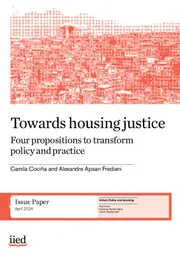
9. Towards housing justice: four propositions to transform policy and practice
The current global housing crisis is sustained by housing systems that do not respond to the reality of the world’s majority. This 24-page issue paper discusses how addressing this crisis through a ‘housing justice’ lens can open up areas of intervention and transformation for policy and practice that can contest unfair and unsustainable housing systems.
It presents four propositions for a justice lens:
- Anti-discriminatory housing policy and practice
- Radically democratic forms of housing production
- Housing as an infrastructure for better cities, and
- Expanded visions for housing futures.
More about this work: IIED is working to advance housing justice by examining how the current value chain of building materials perpetuates climate and social injustices, and by promoting policies that ensure fair access to these materials. This effort includes community-led research, policy dialogues and international advocacy to transform the housing systems, improve climate resilience and enhance the quality of life for informal settlement residents.
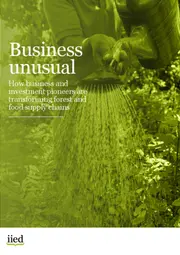
10. Business unusual: how business and investment pioneers are transforming forest and food supply chains
An increasing number of pioneering businesses and investors operating along forest and agriculture supply chains are leading the charge to transform the deeply flawed dominating economic models for the benefit of people, nature and climate.
This 76-page report documents and highlights success and lessons learnt from 18 inspiring examples of businesses and investors who are progressing from ‘business-as-usual’ to ‘business unusual’ by adopting practices that embrace complexity and challenge existing business and investment paradigms and power dynamics.
These pioneers are charting new paths for how forest stewards and farm smallholders can organise themselves, mobilise their own flexible finance, leverage external public and private investments and engage in business partnerships that regenerate and distribute a diversity of social, natural and economic benefits while strengthening social bonds and bonds with nature.
This report identifies three commonly adopted approaches and put forwards four recommendations for governments and public and private funders alike to support these pioneers to drive transformative changes for more distributive and regenerative forest and food supply chains.
More about this work: Biodiversity loss in supply chains heightens climate risks, jeopardising global food security and exacerbating inequality. Collaborating with smallholder farmers in Indonesia, the Philippines and Tanzania, the Nature Nurture project addresses biodiversity loss, enhancing global production systems for improved livelihoods and climate resilience.
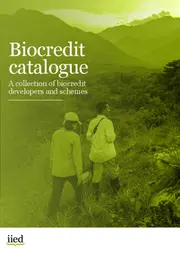
Bonus: Biocredit catalogue: a collection of biocredit developers and schemes
The biocredit market directs finance to the conservation and restoration of biodiversity, which when designed correctly can benefit and empower Indigenous Peoples and local communities, a group which research suggests stewards upwards of 80% of the planet’s biodiversity.
This 19-page catalogue identifies a selection of 11 biocredit developers and schemes currently active, with about 30 pilots under development. It is intended as a living document to support a high-integrity, scalable biocredit market, so please send feedback with any corrections or missing material.
More about this work: The Communities Advisory Panel (CAP) was set up in 2023 to ensure that the emerging market in biodiversity credits (biocredits) is founded on just and equitable principles, respectful of human rights and traditional knowledge, and recognises and builds on existing capacity.
CAP is an independent, self-governed group consisting of over 40 members of Indigenous Peoples and local communities from the seven socio-cultural subregions of the world. The current secretariat of the CAP is IIED, with support from the Biodiversity Credit Alliance (BCA).