Harnessing carbon finance to arrest deforestation: saving the Javan rhinoceros
IIED supported local institutions to set up a properly functioning and equitable forest carbon facility to compensate local villagers for arresting degradation and deforestation in and around Cat Tien National Park. This protection of forests helps conserve large mammals, particularly the critically endangered Javan rhinoceros.

An illustration showing a Javan rhino by W.F.A. Zimmermann, 1861 (via Wikipedia Commons)
Even before the global food price rises, the choices for conserving the last population of Javan rhinoceros were looking dim. Land speculations by the richest and agricultural expansion by the poorest in Lam Dong province were resulting in encroachment onto Cat Tien National Park (CTNP).
There are also plans to upgrade a track to a road within CTNP right through the Javan rhinoceros’ range. This was expected to increase encroachment, the wildlife trade and anxiety of extinction.
At the vanguard of conservation in Vietnam is the Javan rhinoceros. CTNP, one of the few lowland forest ecosystems in Southeast Asia remaining relatively intact and conservable, hosts the last population of the sub-species Rhinoceros sondaicus annamiticus in the world. Yet, there are fewer than ten individuals left.
CTNP is also renowned as one of Southeast Asia’s havens for the conservation of large mammals. Mammals include Asian Elephant, Wild Boar, Sambar Deer and Gaur as well as hosting all six native Vietnamese primate species. It supports several habitats, including lowland evergreen forest, lowland semi-deciduous forest, freshwater wetlands and seasonally inundated grasslands.
The diverse species include 1,300 species of plants, 76 mammals, 322 birds, 73 reptiles, 35 amphibian and 99 fish. These include 40 globally threatened species and 82 species included in the Vietnam Red Data Book.
Conservation through community-based natural resource management is a named goal, and countering the wildlife trade are key priorities for Vietnam driven by international agreements. This project complements Vietnam’s responsibilities under the Convention of Biological Diversity (CBD), which it ratified in 1994. Under the Convention in International Trade of Wild Fauna and Flora (CITES), Vietnam receives criticism for its role as a regional hub for the wildlife trade but is praised for its efforts at implementing legislation.
What IIED did
This priority was a priority for the Vietnamese government, which was keen to avoid talk of extinction and to conserve the 82 critically endangered species who live in CTNP. Yet it faced competing priorities with the poor in Lam Dong province growing cash crops near and inside CTNP. And the park wasn't delivering promised flows of economic benefits to the country, province or the local communities.
This project sought to change this by working with all parties to achieve ‘win-wins’ that result in conservation within the park, economic flows to Vietnam and poverty reduction for poor neighbouring communities
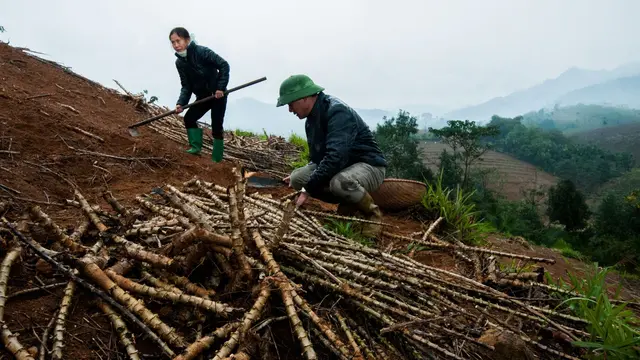
Threats: Gradual encroachment is having a devastating impact on the minimum viable range of many mammal populations in the park, in particular the Javan Rhinoceros. The main cause of forest conversion is to plant ‘cash crops’ – particularly cashew nuts. Vietnam is the largest cashew exporter in the world, with exports totalling US$505 million in 2006, increasing annually by 10% and showing no sign of abating. The area around CTNP is a major cashew growing area, chiefly for the poorest in society since this hardy crop can grow on marginal sloping land with minimal water needs.
Also, the wildlife trade in this area is rampant and is of concern, particularly for the boar, gaur and deer populations. Furthermore, deforestation and degradation associated with agricultural expansion contributes to the emissions of greenhouse gases associated with climate change. The current rate of land cover change from forest to agriculture shows a significant release of carbon stored in the forest.
Developing innovative economic incentives to combat encroachment
Authorities and NGOs agreed that the only way the situation could be reversed is by providing a stronger economic incentive for protection over conversion. To aid this reversal, this project package two key elements of economic incentive – Reductions in Emissions from Deforestation and Degradation (REDD) and co-management.
Structures for both were developed in a participatory way to make sure maximum community acceptance and participation. Participation took place in an iterative manner. First, interviews and group meetings were held with communities in the idea-generating phase, then a set of proposed structures were discussed and evaluated. This was followed by a thorough learning process regarding implementation.
After the UNFCCC Bali negotiations in 2007, there was renewed interest in the issue of REDD. The World Bank piloted REDD, with an expectation that operationally it would allow countries to gain ‘carbon credits’ for reducing deforestation and degradation. Vietnam is one pilot country. The Darwin project carried out the needed feasibility work to implement a mechanism, which allows local communities in the landscape around CTNP to be compensated for reduced deforestation.
The government was keen to pilot REDD in CTNP/Lam Dong because of its conservation heritage, perceived threats and rhinoceros population. This project planned to tap into the mechanism and structures of the World Bank-supported REDD pilot and therefore achieve further benefits.
This project introduced and showed best practice in participatory rural appraisal, pro-poor policy development and alternative livelihood schemes development. It helped develop the local foundations to make sure of equitable distribution of future financing that will genuinely benefit the rural poor.
In the longer term, setting up these mechanisms was intended to provide enough funding to combat the major threats to the National Park. Training of government staff in REDD techniques will help this rapidly-growing initiative to be carried out more successfully in the future in Vietnam.
By examining a range of incentive mechanisms focused around paying for forest conservation, strengthening protected area management, and ensuring empowerment of local communities,the project will support the government’s implementation of CBD and CITES. Encroachment of agriculture into the habitat of critically-endangered Javan Rhinoceroses and other species will be decreased.
Publications


Partners
SNV (Netherlands Development Organisation)
Institute of Tropical Biology
The Department of Forestry