Strengthening agrobiodiversity conservation: ensuring food security and environmental protection
Rural and Indigenous farming communities in the Philippines have long maintained traditional agricultural systems that sustain diverse crop and tree varieties and livestock breeds.
Today, however, these systems are under increasing threat from commercial farming and expanding monocropping, the replacement of traditional seeds with commercial hybrids, and the overuse of chemical fertilisers and pesticides. Land conversion, urbanisation and climate change exacerbate these pressures, placing biodiversity, food security, local livelihoods and cultural heritage at risk.
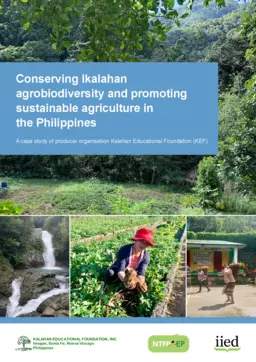
This brief draws on the experience of the Kalanguya-Ikalahan people in Nueva Vizcaya, Philippines, and the work of the Kalahan Educational Foundation (KEF) to demonstrate how supporting traditional farming systems can help conserve agrobiodiversity while strengthening food security, climate resilience and sustainable livelihoods.
It argues that the Kalanguya-Ikalahan experience can inform national policy and be adapted across similar upland and Indigenous agricultural landscapes in the Philippines, and sets out recommendations to institutionalise agrobiodiversity conservation through community seed banks, biodiversity-friendly agriculture and supportive legislation at barangay, municipal, provincial and national levels.
Cite this publication
Available at https://www.iied.org/22751g