Dismantling structural racism and injustice: an update on our progress
Executive director Tom Mitchell reflects on the progress IIED has made on the recommendations from the race audit commissioned in 2022, and on our journey towards becoming an anti-racist organisation.


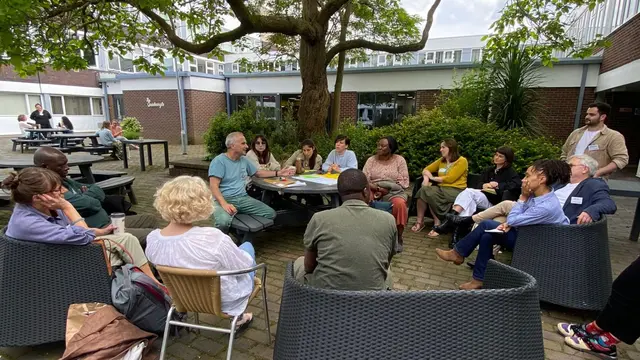
Challenging existing power dynamics was a central theme of IIED’s race audit and an issue that staff have long championed. This image, taken during a workshop at D&C Days 2023, captures discussions between IIED colleagues and partners on the importance of building more equitable partnerships (Photo: IIED, via Flickr, CC BY-NC-ND 2.0)
Today we are sharing our second progress report on how IIED has responded to the audit of race and racism (PDF) carried out in 2022. The process looked at our policies, practices and culture that inhibit our commitment towards becoming an anti-racist organisation.
Following the audit, IIED committed to giving regular public updates as part of our approach to accountability and our goal of being proactively anti-racist in all we do.
I want to take this moment to reflect on our progress and offer some insights from the director of an organisation grappling with these challenges. In doing so, I humbly invite leaders on a similar journey to reflect on their experiences. I believe committing to transparency and honesty, as well as continuous learning, is the least we can do to help dismantle structural racism and injustice.
The report has been thoughtfully compiled by members of our race and racism working group. I invite you to read it, along with the other related reports and insights we have published to date. I also want to acknowledge the group of Black and Brown women (and their allies) in IIED whose tenacity, skill and determination to drive change has brought us to this point.
What have I learned on this journey?
Tackling racism is complex. Much of the work often grouped under diversity, equity and inclusion has been important, but in many ways, it now feels like just a starting point.
At IIED, we have changed lots of aspects: our values, who makes decisions, the way we recruit, the way we train and learn, the way we report harm, the way we recognise key moments and celebrate Black history, the way we resource action, and many other areas. While not wanting to diminish the value of all this work, it now feels like the bare minimum.
Recognise it, name it
Our organisation, our history and the journey we have undertaken are products of a development system and set of world views, funding models and mindsets that have often reinforced racism and coloniality. We understood the importance of recognising it, naming it and striving for change, even when doing so is uncomfortable or can threaten our funding.
We took the decision to include this recognition in our 2024 organisational strategy, our ‘Manifesto for a thriving world’. Our work on equitable partnerships, decolonisation, hidden handbrakes and racial injustice in financing nature provide examples of areas where we have spoken more openly and directly.
Our values have helped guide us on this journey, even as public and political attacks on diversity, equity and inclusion have intensified. When we published some of this work, I recall receiving direct messages from people: “you’re brave”, “is that wise?” and “great to see IIED championing this when others are keeping quiet”.
Intersectional justice
But the more we have framed this work as a commitment to anti-racism, the more we have discovered the complex interfaces between different identities and oppressions.
Voices from across IIED have been resolute in making the point that focusing too heavily on anti-racism alone can divert attention from intersectionality, disability and decoloniality, for example.
Leading to many internal debates, this has helped us evolve our thinking and framing of the challenges. We now talk increasingly and more explicitly about intersectional justice. The new role of intersectional justice lead, reporting directly to me, helps bring together the different elements while maintaining focus on anti-racism.
Part of our DNA
A recurring reflection from the last four years is that much of the work has involved putting basic foundations in place, often driven by a relatively small group of committed people. We’ve struggled to mainstream the more systemic approaches to tackling structural racism or the intersectional justice agenda, including in the practice of all our leaders across IIED.
This is also true of some of our external impact-focused research teams and core research and impact methodologies.
IIED has been hit by funding cuts and an internal restructure has followed. But we have seized the opportunity created by the need to change in several ways, including by:
- Creating space for a conversation with our board of trustees about our future as an organisation, guided by our learning and experiences around intersectional justice and decolonisation
- Changing the job descriptions of most of IIED’s senior leadership to reinforce accountability and responsibility for intersectional justice and anti-racism
- Throwing another lens on how we make decisions and what we expect of our teams in the way they design our external impact agenda and raise money, and
- Continuing to review and learn from how we implement these changes.
These are essential steps that will allow us to make this agenda part of our DNA: in our practice, in the way we govern ourselves and in how we hold ourselves to account.
An ongoing journey
Finally, I have been asking myself whether some of these changes should have happened sooner.
Maybe. There are times, as we’ve debated internally, where progress has felt slow, and people (including me) have undoubtedly felt frustrated. But I have come to understand the importance of recognising and exploring those tensions and polarities, and firmly believe they are part of our developmental journey.
This second report notes that our progress has been non-linear, punctuated by the ups and downs we and many other organisations in the development space have experienced in recent years. But it feels important to reflect on the trends and not the noise, and be a little forgiving of ourselves in acknowledging that doing anything hard and in need of collective action takes both determination and persistence.
The more I learn about structural racism, the more I realise how much I still need to learn. Maintaining constant curiosity and a commitment to challenge myself, ourselves, feels like a key part of this journey.