Climate finance for least developed countries: lessons on locally led adaptation
As momentum builds towards the UN climate change conference (COP29), IIED’s Tracy Kajumba looks at how the Least Developed Countries Initiative for Effective Adaptation and Resilience (LIFE-AR) is putting the principles of locally led adaptation into practice.



Tree seedlings being watered and tended in Vrassan, Burkina Faso (Photo: CIFOR-ICRAF, via Flickr, CC BY-NC-ND 2.0)
Following September’s UN Summit of the Future and looking ahead to COP29, the need to reform the global financial architecture and set an ambitious new goal for international climate finance continues to be reaffirmed.
Adaption finance is key to supporting climate action in the worst-affected communities: however, recent studies show that finance for climate action is not accessible to the least developed countries (LDCs) at the speed and scale needed to adapt to climate risks and uncertainty.
For instance, in 2021 the majority of climate finance – 61% (US$384 billion) – was raised as debt, of which 12% ($47 billion) was low-cost or concessional debt.
This impoverishes LDCs and other countries vulnerable to climate impacts as they borrow to address adaptation needs. Debt repayment leads to adaptation and development deficits, reversing progress and keeping LDCs in a cycle of borrowing.
LIFE-AR was developed to respond to the challenges LDCs face in accessing climate finance. Unequal power dynamics and partnerships dictate that any available adaptation finance takes a low-risk approach, prioritising short-term, top-down and siloed approaches that have temporary or limited impact.
LIFE-AR aims to redefine LDCs’ relationships with other development partners so that they can determine their own climate priorities and use their own systems to address challenges. This involves devolving decision making to the lowest appropriate level and seeking inclusive participation that centres local communities in climate decision making.
The approach taken by LIFE-AR aligns with the principles for locally led adaptation (LLA) endorsed by over 130 government and non-government institutions: our recent publication demonstrates this LLA alignment, with more examples starting to emerge.
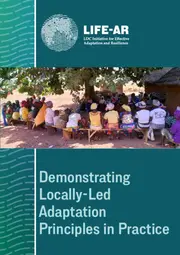
Closing the climate finance gap: our lessons so far
Implemented in 10 LDC countries, LIFE-AR focuses on establishing systems, building capabilities and designing delivery mechanisms that work within government systems to get finance to the local level. Here are five lessons we have learned on using locally-led approaches:
- Systems and capabilities for long-term access to climate finance must be built
Access to climate finance has been short term, projectised and transactional. LDCs still experience challenges with meeting accreditation requirements, reporting burdens and dealing with intermediaries. Developing delivery mechanisms that strengthen government systems long term will provide trusted, capable channels of delivering climate finance across scale. We are still grappling with intermediation, but countries are analysing its impact and working on influencing strategies with funders.
- Setting targets on adaptation finance that should reach the local level improves accountability
LIFE-AR aims to invest at least 70% of climate finance in community priorities. This target is supported through delivery mechanisms that take ‘whole-of-society’ and ‘whole-of-government’ approaches, featuring national platforms with cross-ministry representation to support action in communities. We have worked to define what this 70% entails and how it will be achieved: an ambitious task, but the only way to be accountable.
- Adaptation Investments need to be informed by climate risk assessments
Projects that are not informed by climate risk analysis fail to address climate impacts on communities and can lead to maladaptation. Researchers and practitioners continue to question what effective adaptation looks like on the ground, due to a lack of understanding of what drives vulnerability. In our experience, most countries lack updated climate vulnerability data – or it is neither up to date nor location-specific. LIFE-AR assesses location-specific climate risks by using existing participatory and gender analysis tools, to inform the choice of investments.
- Flexibility, adaptability and learning are key
Programmes driven by bureaucratic processes such as rigid accountability, rules, reports and deadlines – without consideration for long-term climate impacts – cannot be effective. LIFE-AR takes a flexible approach, working with development partners funding the initiative. This is done through pooled funding, joint reporting, innovative monitoring, evaluation and learning systems, country-determined budgets and by using peer learning to reframe what does not work. This takes a level of trust and commitment but can deliver long-term results.
- Addressing gender and social inclusion to manage ‘elite capture’ is vital
While efforts on gender and climate integration have progressed globally, studies show gaps in the equitable representation of women and other groups; this hinders integration of their perspectives in climate decision making and investments. LIFE-AR takes a systems approach that focuses on integrating gender equality and social inclusion (GESI) into the governance and programme cycle, with a global GESI thematic community of practice that enables countries to learn from each other and find solutions together.
How funders can avoid business-as-usual approaches
The LLA principles are a guide: without genuine commitment they will not deliver the expected results. It is time to change ways of working and transform how funds reach governments and communities.
But how do we reform the systemic, bureaucratic approaches that shape delivery of climate finance to local levels? What does locally led look like? And how can inclusion be more meaningful than just counting numbers?
First, reduce transactional costs for LDCs and other recipient organisations. Adaptation processes will never truly be locally led when power and control lies with providers of funds. Different funds have different standards and reporting requirements, which take time to fulfil. LIFE-AR advocates for the principle of working jointly on a shared and equal platform, with climate finance flowing through LDC mechanisms to reduce intermediaries.
Harmonising different criteria across funds, where one government does not have to be assessed by numerous funders, would be one step. Another would be to accredit more government entities, to enable capabilities for long-term access.
Second, embrace long-term, adequate investment to scale up adaptation. Short-term projectised funding, with small quantities that cannot meet country and community needs, will not fulfil LLA requirements and will impede innovation.
While adaptation to intensifying climate impacts is needed, investment is still low: studies show that adaptation finance (in the 2021 assessment) represented just 14% of total public finance. It is time to move from rules and regulations to providing long-term, predictable and increased investment in adaptation.
Third, promote equitable partnerships to enhance climate action. Partnerships between institutions can be skewed by unequal power dynamics based on who holds the resources and decision-making power. In contrast, LIFE-AR offers an opportunity for LDCs and international development partners to be accountable to each other in fulling the commitments of working in 'business-unusual' ways.
Only then can we shift the narrative away from donor-recipient relationships and towards more meaningful ones based on equity, recognising that climate change is a global crisis that has no respect for hierarchies. As COP29 approaches, let’s hope that funders will move from rhetoric to action.