IIED's founder: Barbara Ward
The founder of the International Institute for Environment and Development (IIED), Barbara Ward was a pioneering economist, writer and public speaker. She was one of the first people to articulate the concept of sustainable development and what was needed to underpin it, and her vision still inspires IIED's work today.

IIED founder Barbara Ward (Photo: Mark Edwards)
A champion of sustainable development
Environmental campaigners know Ward for her book "Only One Earth: The Care and Maintenance of a Small Planet".
In this book, published in 1972 with Nobel laureate René Dubos and marshalling contributions from 150 international experts, she writes of the need to "clearly to define what should be done to maintain the earth as a place suitable for human life not only now, but also for future generations". This is generally considered the first definition of the concept of sustainable development, and became the basis for the Brundtland Report definition 15 years later.
The book served as the unofficial handbook for the landmark 1972 United Nations Conference on the Human Environment in Stockholm. But a year earlier Ward had
worked on the 1971 Founex Report, the first international paper to identify key environment-development objectives and relationships, which contributed to bridging the differences that separated developed and developing countries in Stockholm.
In her later years Ward, who also held the position of professor of international economic development at Columbia University in New York, was especially concerned about the growth of urban poverty and the conflict between economic development and protection of the environment.
In 2000, she was named one of the 20th century's most influential visionaries by Time magazine, and in 2014 Ward was honoured posthumously with a stamp in the Royal Mail's Remarkable Lives series, which celebrated 10 extraordinary people who were born 100 years previously.

The remarkable Barbara Ward, whose life was celebrated in stamp form in 2014
The early years
Ward was born on 23 May, 1914 in Heworth, York, but grew up in Felixstowe. Her father was a Quaker, but she was raised as a Roman Catholic. Both faiths influenced her throughout her life.
She began her education at the local convent and then went on to study in France and Germany. In 1932, she returned to England to attend Oxford University. She graduated with the highest honours in philosophy, politics and economics and worked for the Ministry of Information during the Second World War.
In 1950, Ward married Robert Jackson, an Australian development expert working with the United Nations. They had one son. The couple lived in Africa and Asia where she gained personal insights into development issues.
Journalism and writing
She published her first book at the age of 24. The book, titled "The International Shareout", was on the subject of the growing gap between rich and poor countries, a theme that was to occupy her thinking for the remainder of her life. In 1939 she joined The Economist as an assistant editor, eventually becoming its first female foreign editor aged just 28.
In addition to the groundbreaking 'Only One Earth', Ward also wrote 'The Home of Man' in 1976, which was commissioned by the Canadian government for the UN HABITAT Conference in Vancouver and analysed global urban growth, and three years later 'Progress for a Small Planet', which outlined global resource bargains, basic human needs and sustainable livelihoods.

Barbara Ward (standing side-on centre), is pictured with early IIED staff, including David Satterthwaite (back row, third left)
Ward was a skilled communicator; books such as 'Only One Earth', which was published in 13 languages, were bestsellers. The Book of the Month club sent out 300,000 copies of 'The Rich Nations and the Poor Nations', published in 1962.
IIED senior associate David Satterthwaite, whose 50-plus years working for the institute started as Ward's assistant, recounts that when her literary agent pointed out to her that a publisher in India had produced an unauthorised edition of one of her books, Ward suggested sending the publisher a congratulatory telegram.
International campaigning
Ward continued to publish books during the 1950s and 1960s and played a major part in highlighting the economic problems of the developing world.
In 1957, she was appointed to the Department of Economics at Harvard University with a grant to study development assistance. She spent much of the next decade travelling between the United States and Africa and Asia.
Wide friendships and far-reaching influence
Although she was a widely published author, her greatest influence was as an informal advisor to international leaders, and her networking skills were renowned. Among the world leaders whom she counted as friends were Indira Gandhi and Willy Brandt, as well as US presidents John F Kennedy, Lyndon Johnson and Jimmy Carter, as well as several UK prime ministers and heads of state from Africa and Asia.
She helped JFK frame US foreign policies towards justice and peace and helped inspire Robert McNamara to lead the World Bank's crusade against poverty. She also exerted considerable influence on the Roman Catholic Church and played a key role in persuading Pope Pius XII not to oppose the first World Population Conference in 1954.
Other interests
Ward's interests ranged widely. A talented opera singer (she considered becoming an opera singer but said the competition was much fiercer than for economists), Ward became a trustee of Sadler's Wells and of the Old Vic theatre in London. She was also governor of the BBC.
She was first made a Dame, then in 1976 she became a life peer as Baroness Jackson of Lodsworth.

IIED founder Barbara Ward was an impassioned public speaker, and her presence was much anticipated at events
The IIED years
Following the landmark Stockholm conference in 1972, summit secretary-general Maurice Strong and philanthropist Robert O. Anderson invited Ward to become president of the International Institute for Environmental Affairs (IIEA), which had been founded in New York in 1971.
Ward accepted the presidency on one non-negotiable condition: that the word "development" be added to the institute's name and mandate. She declared: "Without [development], the concept of preserving the environment has no real meaning for the poorer two-thirds of mankind."
In 1973, the organisation was reconstituted as the International Institute for Environment and Development (IIED), a policy research organisation to work in partnership with organisations across Africa, Asia and Latin America to promote sustainable development. Ward later established its primary headquarters in London.
During her tenure as president, until 1980, Ward established the institute's core ethos: demonstrating that environmental conservation cannot be separated from poverty reduction, basic human needs and social justice.
In May 1980, Ward was awarded the Albert Medal by the UK Royal Society of Arts in recognition of her leadership in international economic cooperation. Although she was unable to attend the ceremony due to failing health, her acceptance message stated: "Tell them that the development and betterment of the poorer two-thirds of the world is the most important task before us all in the remainder of this century... That is the message I want to give as long as I live, and through our institute for longer."
She died on 31 May 1981, and Pope John Paul II sent a cardinal to represent him at Ward's requiem service. Her obituary in The Economist recorded: "For the last decade of Barbara Ward's life the IIED was perhaps her first secular interest. She worked for it unremittingly with an energetic staff."
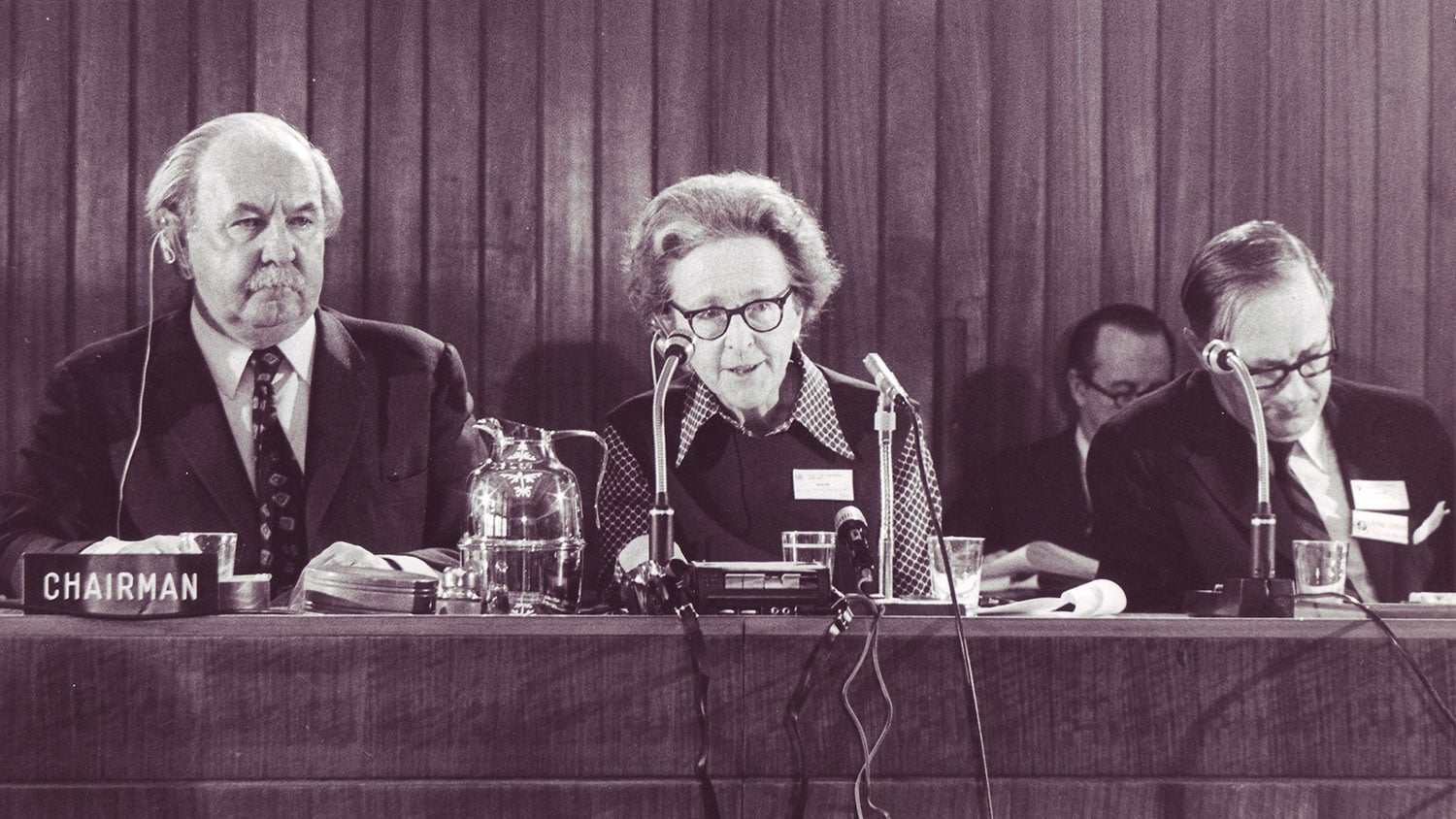
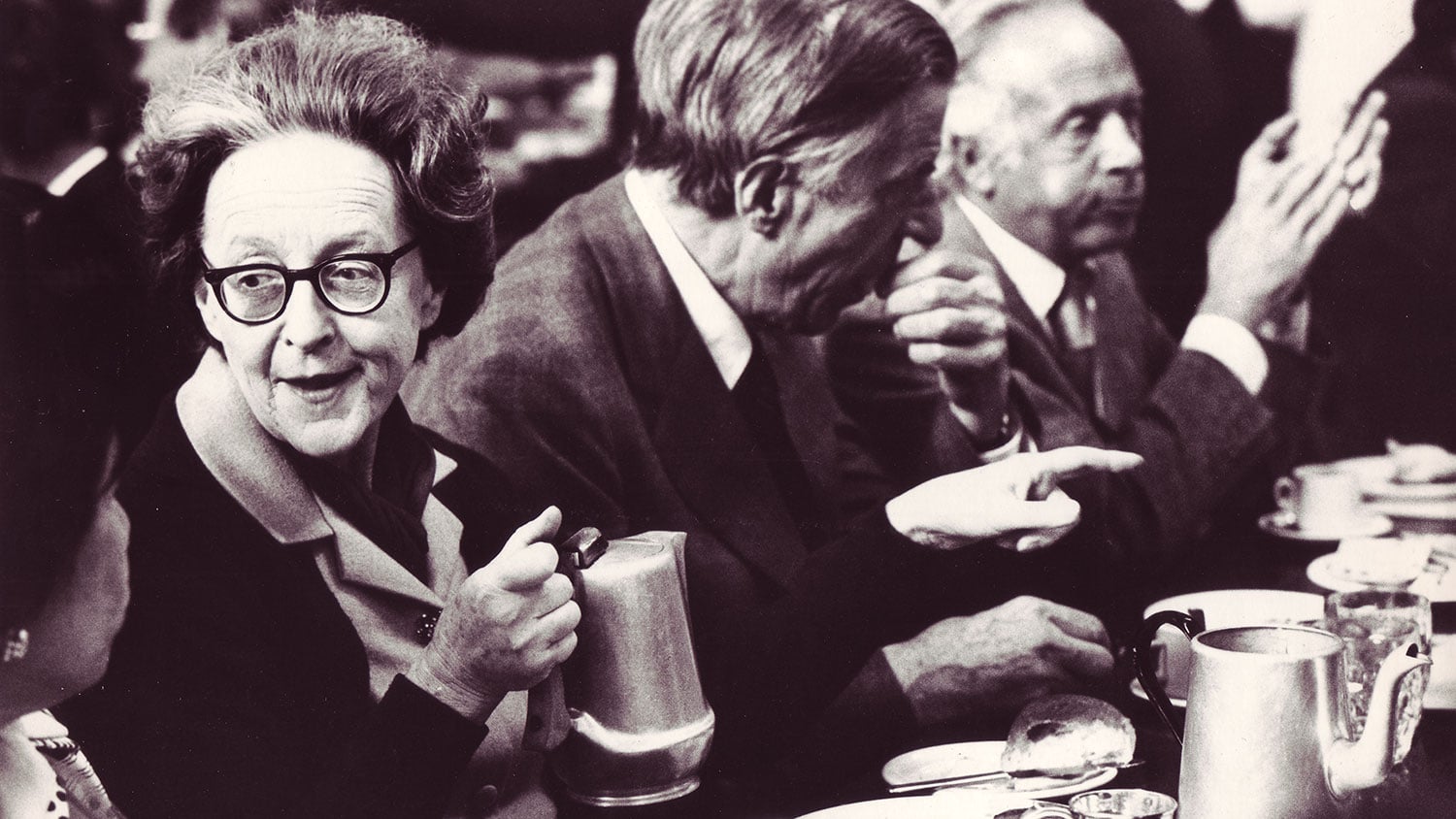
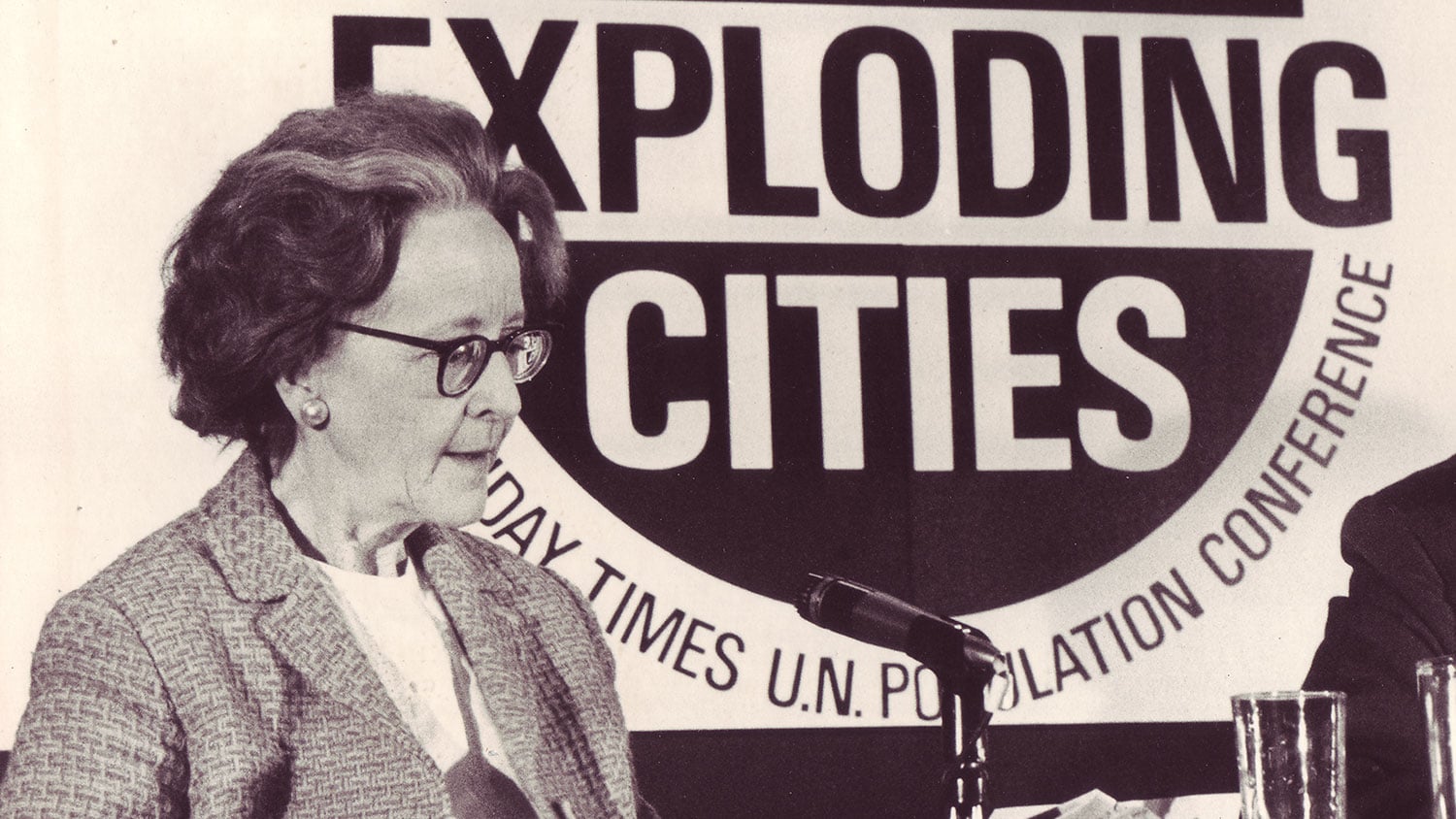
Barbara Ward worked tirelessly to advance the sustainable development agenda, including at some of the world's biggest conferences. Click on the images and scroll through the gallery
The Barbara Ward Lectures
Ward was a passionate and highly regarded speaker whose lectures did much to influence public opinion and international policy.
In honour of her work, IIED organises a series of Barbara Ward Lectures by leading women in the field of sustainable development. Previous speakers have included former Ireland president and the first UN commissioner for human rights Mary Robinson; former executive secretary of the United Nations Framework Convention on Climate Change Christiana Figueres; and ex-Norway Prime Minister Gro Harlem Brundtland.
In her own words
Watch Barbara Ward calling for a more equitable distribution of the earth's resources in the video below (also available on IIED's YouTube channel).
This edited collection of clips are from the landmark film 'Survival of Spaceship Earth', which was produced in 1972 for the first United Nations conference on the human environment.
Tributes
To mark 100 years since Ward's birth, in 2014 IIED commissioned a series of articles and interviews to remember its founder.
A video playlist available on IIED's YouTube channel includes interviews with former IIED director David Runnalls (below) and Satterthwaite, plus a speech by John F Kennedy at Boston College in 1963, when Ward was awarded an honorary degree. There is also a compilation with tributes from colleagues.
Further reading
Insight: A vision of our world that is sustainable, fairer and realisable: memories of Barbara Ward, David Satterthwaite (May 2014)
https://www.iied.org
Barbara Ward and the Origins of Sustainable Development, David Satterthwaite (2006), book


