Global climate finance leaders unite in London to "supercharge" climate resilience finance
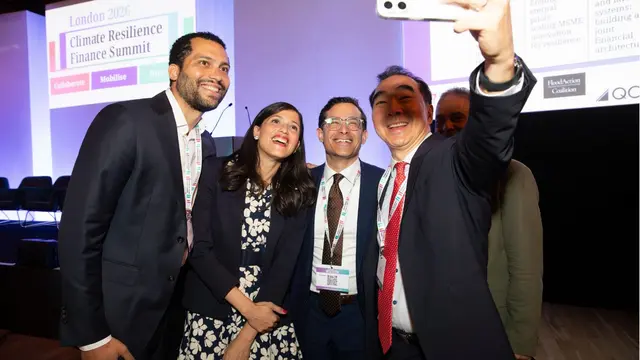
Climate finance leaders from six continents gathered at the 2025 London Climate Resilience Finance Summit last week, joining heads of state, senior government ministers, finance and business leaders, and civil society to tackle one of the most pressing challenges of our time.

Wopke Hoekstra, EU Commissioner for climate, net zero and clean growth, speaking at the 2025 London Climate Resilience Finance Summit (Photo: European Commission)
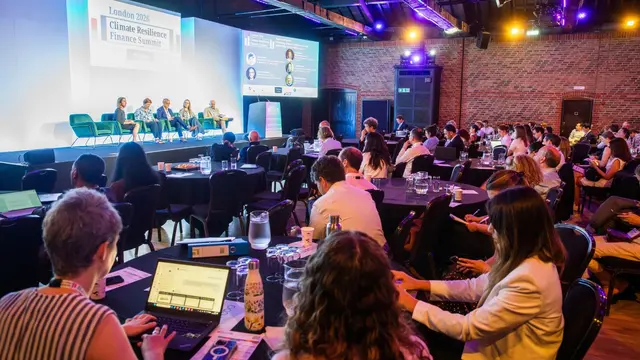
More than 450 climate finance leaders were at the high-profile event, held as part of London Climate Action Week, which marked a significant milestone in efforts to bridge the massive funding gap for climate adaptation and resilience worldwide.
The concept for the summit was devised in December 2024, when a coalition of around 15 organisations shared their dreams and ambitions for the event. Having observed a gap in the agenda for an event to provide the prominence finance for climate resilience deserves, they set out to design a summit that had a chance of making a desperately needed breakthrough.
Inclusivity was paramount, with minimal barriers to entry, so the summit featured free tickets and the potential for organisations to pitch their challenge sessions and be part of shaping the event. This brought together the full breadth of the ecosystem so crucial to supercharging finance for climate resilience at a crucial moment –from institutional investors in London to local community resilience cooperatives in the Majority World.
High-level opening
Her Excellency Minister Marina Silva, Minister for Environment and Climate Change in Brazil, opened the summit, followed by a keynote address from Wopke Hoekstra, commissioner for climate, net zero and clean growth at the European Commission.
The day-long event featured three plenaries, 15 collaborative ‘challenge’ sessions and a high-level riverside dialogue, and its ambitious agenda was designed to move beyond passive listening to active problem solving, to collaborate, innovate and mobilise climate resilience finance.
Global representation
Delegates represented the full spectrum of the climate finance ecosystem: government officials, multilateral institutions, philanthropic organisations, investors, banks, research bodies, civil society groups, NGOs, regulators, credit rating agencies and grassroots organisations.
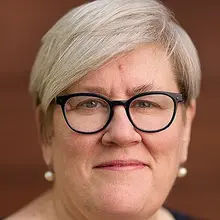
It just takes a few people to create a paradigm shift… and many of those people are sitting on this panel
- Rachel Kyte, UK Special Representative for Climate
This diversity was by design, organisers noted, reflecting their goal to "showcase London as a place where this ecosystem can meet and draw in the power and scale that London has to offer".
Looking to COP30
The summit concluded with a high-level panel featuring Ambassador Andre Correa do Lago, President-Designate of COP30, who looked ahead to the upcoming UNFCCC conference in Belem this November. He was joined by Ruth Davis, UK Special Representative for Nature, Sheela Patel, founder of SPARC, and Linda Freiner, chief sustainability officer at Zurich Insurance Group.
“Every room I've been in has been full of people with extraordinary ingenuity and human beings have got such incredible resources to call on that if only we're given the opportunity,” said Davis.
“It's clear that there are more solutions out there than we can… possibly capture or describe. It's opening a door for the opportunity of all that human ingenuity to solve the problem in front of us.”

Closing panel featuring remarks from Tom Mitchell, Ambassador Andre Correa do Lago, Ruth Davis, Sheela Patel and Linda Freiner (Photo: Benjamin Mole/IIED)
The day's key messages started to come together in the closing plenary, where delegates shared the powerful insights and actionable solutions that had emerged. These were:
- Blended finance is a key, under-utilised, modality to increase finance for resilience, but it isn’t a silver bullet
- We need to take holistic approaches to development and climate, and adaptation and mitigation. Siloes aren’t getting us to where we need to be
- We need to bridge divides in language and approaches between public and private, and local and global, to ensure no one is left behind
- We need to move fast, but with care. The challenge is urgent. We have the tools, systems and approaches to scale resilience finance, but we need to be context-aware to ensure we have sustainable impact
- The quality of finance is just as important as the quantity, and
- Diversity and inclusion are critical. We can’t make good decisions on adaptation and resilience investments without all stakeholders having a voice – and a vote.
These key messages are now being fast-tracked for development by the summit sponsors and programming partners. These insights could reshape how we approach climate resilience finance, so there will be more to come.
Sponsors
Our sponsors contributed strategic thinking, expertise and financial support at various levels throughout the summit. The summit was sponsored by British International Investment, Foreign, Commonwealth & Development Office, Howden Group, Quadrature Climate Foundation, Wellcome Trust and Zurich.
Contact
Clair Grant-Salmon ([email protected]), head of marketing and events