Emerging principles for supporting locally-led biodiversity action
In September 2024, representatives of Indigenous Peoples and local communities, international organisations, NGOs, government agencies and donors met in the UK to discuss how best to progress action towards a more inclusive, gender-responsive and locally-led approach to halting and reversing biodiversity loss. As the COP16 biodiversity summit begins, Dilys Roe and Helen Poulsen reflect on the outcomes of the meeting and the key principles that emerged from it.




In Zimbabwe, communities vulnerable to climate change are adopting climate-resilient agricultural practices and cropping systems by accessing and utilising climate information to more effectively manage risk in rain-fed and irrigated agricultural production (Photo: UNDP Climate, via Flickr, CC BY-NC 2.0)
At the beginning of September 2024, the UK government’s Department for Environment, Food and Rural Affairs (Defra) convened a meeting at Wilton Park, near London, in the run up to the 16th meeting of the Conference of the Parties to the Convention on Biological Diversity (COP16). Nearly 55 participants from across the world gathered to discuss and debate the key barriers to achieving the transformative change that is required to ensure the ambitions enshrined in the global biodiversity framework (GBF) are met, and to explore the solutions to those barriers.
After two days of discussion, participants – including representatives from IIED – agreed on a set of principles that outlined how transformative action could be better supported.
The principles draw on the principles for locally led adaptation (developed under the auspices of the Global Commission on Adaptation) and on the Shandia Principles (PDF) (developed by the Global Alliance of Territorial Communities) – as well as the outcomes of discussions held during the conference.
A seven-point framework
Set out in a seven-point framework, the principles offer governments, donors, NGOs and other stakeholders practical steps towards a more inclusive, gender-responsive and locally led approach to halting and reversing biodiversity loss. Presented here in summary form, and in full detail in the meeting report, they are:
1. Recognise and respect the rights, knowledge and capabilities of Indigenous Peoples and local communities, especially women and youth
It is essential to recognise, acknowledge and advance the rights, knowledge and capabilities of Indigenous Peoples and local communities – especially women and youth – as essential partners for reversing biodiversity loss, combating climate change and achieving sustainable development.
2. Devolve decision making to, and build capacity at, the appropriate local level
Give local institutions, including Indigenous Peoples and local communities, increased decision-making power over how biodiversity protection, restoration and sustainable use interventions are defined, prioritised, designed and implemented, and over how progress is monitored and success is evaluated.
Improve the capabilities, leadership and capacity of local institutions and organisations to facilitate and manage impactful biodiversity initiatives over the long term and reduce dependence on project-based funding.
3. Recognise and address structural and intersectional inequalities faced by women, youth, children, disabled people, displaced people, Indigenous Peoples and marginalised ethnic groups
Recognise and address the inequalities that are often the root causes of social, economic and political vulnerability. This includes through creating mechanisms for full, equitable, inclusive, effective and gender-responsive participation, leadership and decision-making, and ensuring equitable access to resources and benefits arising from biodiversity action.
4. Encourage flexible, adaptive biodiversity programming through the provision of patient, flexible, predictable and accessible funding
Make the processes of financing, designing and delivering gender-responsive, locally-led programmes more streamlined, simple and transparent. This involves ensuring mutual accountability between local stakeholders and donors or intermediaries, and ensuring that decision-making power is shared and transparent across all levels.
5. Utilise scientific, local and traditional knowledge to fully understand biodiversity risks and opportunities, and learn from experience
Build a robust understanding of biodiversity risks, opportunities, uncertainties and definitions of success through a combination of different forms and sources of knowledge. Recognise, account for and report local actions and achievements as contributions to formal national and international targets and commitments, and share experience to inspire others.
6. Promote collaborative and coherent action and investment
Encourage inclusive collaboration between stakeholders across sectors, initiatives and levels (including across government policy areas) to ensure that different initiatives and different sources of funding support each other. Prioritise partnerships that amplify the leadership of local actors, particularly women and underrepresented groups, and ensure that their priorities and knowledge drive collective action to enhance efficiencies and good practice.
7. Actively prevent, or mitigate the risk of, harm
Rather than reacting to problems once they have arisen, take proactive actions to protect local stakeholders – including environmental human rights defenders – from harm (including gender-based violence and actions that undermine their agency or cause further marginalisation).
Why now?
There is a growing body of evidence that Indigenous Peoples and local communities are the most effective stewards of biodiversity. The global assessment of the Intergovernmental Science Policy Platform on Biodiversity and Ecosystem Services (IPBES) highlighted that while biodiversity is being lost across the globe, it is being lost at a slower rate on land owned or managed by Indigenous Peoples and local communities.
Meanwhile, research by IIED and partners has shown that protected and conserved areas that have equitable governance systems deliver better outcomes for biodiversity and for people.
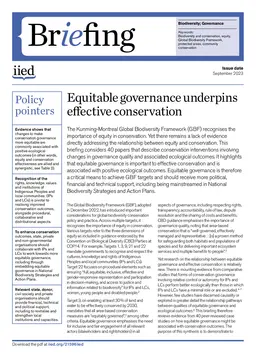
A summary of the research that helped to inform the Wilton Park conference is available online. While the evidence is compelling, we still see limited progress in many places. These principles, outlined above, provide a guiding framework to help governments, donors, NGOs and other stakeholders build on that evidence base and really put their commitment to locally-led action into practice.
As countries gather at COP16 in Colombia this week to firm up their commitments to implement the GBF – and to finance its implementation – the principles for locally-led action on biodiversity provide insights into the kinds of enabling actions that are vital for maximising our collective chances of success.