Reducing Emissions from Deforestation and forest Degradation (REDD+)

UN Climate change conference (COP 18/CMP8)
Article
Some researchers will attend the climate change talks and support the Least Developed country negotiators at this year’s climate conference while others will lead side events. Find out more.
Flooded sugar cane fields near Colombia's third largest city, Cali, during an intense rainy season.
Blog entry
Many Latin American countries are showing how the pursuit of low-carbon strategies can create ‘win-win’ scenarios for economic growth and forest protection.
A villager gathers medicinal bark in Mozambique
Blog entry
Putting less emphasis on carbon payments and more on supporting sustainable enterprise could give REDD+ projects longer-term financial security.
A man stands by a tree stump in Mozambique.
Blog entry
While REDD+ is aimed at reducing emissions from forests, its effectiveness will depend on how much the benefits trickle down to those living closest to the forest.
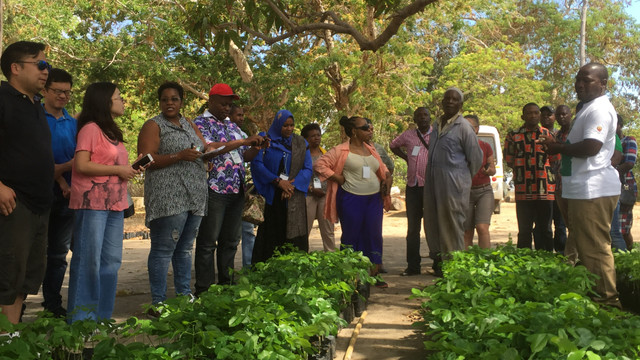
A large group of people sit under a tree and talk.
Blog entry
Does the treatment of forests at home influence what different donor nations prioritise and support abroad?
Coral Reef. Economists at the BioEcon conference Credit: Magnus Manske (creative commons)
Blog entry
Economists continually fail to get the message across. Nowhere is this more evident than in dealing with ecosystem services.
Women discuss forest management at a Community Forest User Group meeting in Nepal.
Blog entry
Women are routinely excluded from REDD decision-making processes, but if they’re excluded then they can’t benefit equally from its work.
Discussing free, prior and informed consent in REDD+
Blog entry
How could obtaining the free prior, and informed consent of communities be applied to REDD+, a scheme that aims to compensate communities for keeping their forests standing?
Forested hills in Nepal, with a house in the foreground and forested hills, and then clouds behind.
Media release
Income generated from REDD+ should be given to forest communities to invest in their future, recommends a new report by The Forests Dialogue (TFD). Investing locally in this way should be part of understanding REDD+ as integral to broader development among forest-dependent communities.
Media release

World Forest Day last week focused international attention on the urgency of better managing forests for food, fuel, climate change and natural disaster responses at a time when the stakes have never been higher.

Pages

Subscribe to RSS - Reducing Emissions from Deforestation and forest Degradation (REDD+)