Sustaining local food systems and agricultural biodiversity
How and under what conditions can decentralised governance, capacity building and participation by farmers promote food systems that adapt to changing conditions and climates and maintain agricultural biodiversity?
Principal researcher and team leader (biocultural heritage), IIED's Natural Resources research group

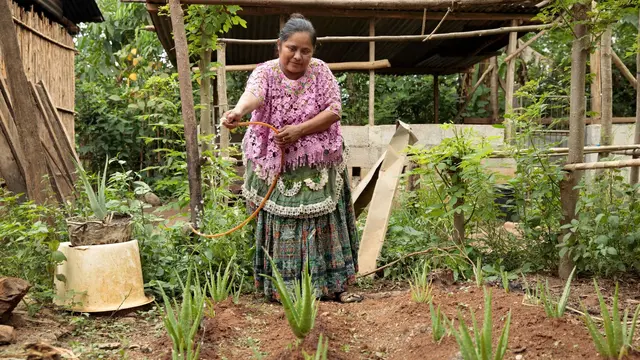
Drying medicinal plants, the knowledge of which is passed down through generations. In South Asia alone, there are more than 8,000 plant species with known medicinal value (Photo: copyright Bioversity International/B. Sthapit)
This project collaborated directly with local farming and indigenous communities in regenerating biodiversity-rich farming and locally-controlled food systems in India, Indonesia, Iran, Mali and Peru to provide some answers.
The aim of the project was to:
- Identify forms of decentralised governance, co-management agreements, and markets and property right institutions able to sustain agricultural biodiversity and livelihoods
- Strengthen the capacity of farmers and other actors, including producer organisations, and promote awareness and responsible action
- Develop indicators to analyse the links between livelihoods and agricultural biodiversity, with a special emphasis on local definitions of wellbeing, equity and culture
- Apply participatory assessment methodology for valuations of agricultural biodiversity and the various systems (for example, livelihoods, food and rural development) in which local biodiversity was embedded, and
- Make recommendations on effective policies and processes to help build capacity and institutionalise the adaptive management of agricultural biodiversity in the context of localised food systems and rural economies.
What IIED did
Through participatory research and dialogue in India, Indonesia, Iran and Peru, and international learning exchanges, a range of activities were carried out. These included:
- A citizens’ jury in 2001 in Andhra Pradesh, India, that included small farmers and indigenous people in participatory assessments of different visions of food, farming and rural development futures
- An international farmers exchange for mutual learning on privatisation of knowledge and seeds in Nyeleni, Mali, in 2009
- A farmers’ cultural and technical exchange between Indian farmers and indigenous communities in the Andes of Peru. The farmer-to-farmer exchange focused on capacity building for the local level management of agricultural biodiversity, the documentation of indigenous knowledge in the form of Community Biocultural Registers and training in digital video technology.
We also supported and advised the Growing Diversity Initiative and an international workshop in Brazil in 2002, in which participants reviewed emerging issues and challenges for the decentralised management of agricultural biodiversity in Africa, Asia and Latin America.
An international training workshop was held in September 2009 in Cusco, Peru on methods and processes for establishing indigenous biocultural territories as agrobiodiversity conservation areas. This workshop produced a declaration to emphasise the participants’ commitment to working together towards ensuring food sovereignty and fostering locally-led initiatives for the protection and promotion of agrobiodiversity and local rights.
The workshop in Peru was followed by a meeting held by Peruvian indigenous organisations, local government bodies and civil society organisations in Cusco, in February 2012. The meeting formulated a strategic response to a United Nations Food and Agriculture Organization (FAO) meeting (ABCD10) that would push for greater use of genetically modified organisms. A demonstration through the ancient Inca streets followed.
The meeting produced an open letter to the director general of FAO that stated that the FAO agenda didn’t represent the best approach for tackling agricultural challenges, including those brought by climate change.
After this initiative came to an end, IIED support continued through other projects, notably in the Potato Park, Peru.
News and updates

Publications


Additional resources
Sharing power: earning by doing in co-management of natural resources throughout the world, Grazia Borrini-Feyerabend, Michel Pimbert, Taghi Farvar, Ashish Kothari, Yves Renard (2004), IIED Book
Campaign website: ¿Transgénicos? No, gracias (Spanish)
Video: Viva Cusco Libre de Transgenicos (Spanish)
See also the related biocultural heritage website.
Partners
Farmer Initiatives in Ecological Literacy and Democracy Foundation (Indonesia)