Supporting pastoral mobility in East and West Africa
Livestock mobility is crucial for ensuring high livestock productivity in environments where nutritious pastures and water are highly variable in time and space. It is also important for market access and building prosperous and peaceful societies in the drylands. IIED and partners documented a number of successful initiatives to facilitate mobility and experimented with scenario planning to help empower pastoralists and allow them to influence decisions on policy or resource allocation.
Senior fellow, Climate Change; team leader, climate resilience, productivity and equity in the drylands

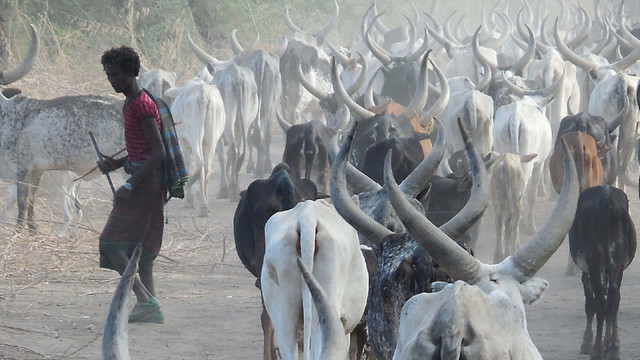
WoDaabe pastoralists are one of the most mobile and specialised pastoral communities in the Sahel (Photo: Stephen Anderson)
Documenting what works
In several African countries, initiatives to facilitate livestock mobility and remove the obstacles that constrain otherwise flexible pastoral systems have seen some success. IIED and partners documented these efforts in a series of country studies that focus on the factors that affect livestock mobility and explore what governments, development workers and researchers have done to promote it.
Funded by the Howard G. Buffett Foundation, the reviews draw together lessons from initiatives in ten countries across East and West Africa, including:
- Mali (with Sahel Eco)
- Burkina Faso (with CEFRAP)
- Niger-Nigeria (with Billatal Maroobe and AREN)
- Chad (with IRAM)
- Sudan (with SOS Sahel-Sudan)
- Ethiopia-Somaliland (with SOS Sahel-Ethiopia; Tufts University and Save the Children/USA)
- Senegal (with Associés en Recherche et l’Education pour le Développement)
- and the Karamajong cluster – an area comprising northeast Uganda, northwest Kenya, southwest Ethiopia and southern Sudan (with RECONCILE and the Uganda Land Alliance).
We also produced an analysis of the policy environment in East and West Africa.
 Modern and mobile, available in English and French, brings together the words of pastoralists and experts from across the drylands of East and West Africa. Using scientific research data and information from the case studies above, it challenges persistent misconceptions that pastoralism is outmoded and uneconomic.
Explaining the reasons behind mobility, the book shows that mobile livestock feed better, produce more meat and milk, are healthier and deliver more calves than sedentary animals. The book reveals the real value of the national and international trade in livestock and the crucial need for mobility during Africa’s frequent and naturally occurring droughts.
Scenario planning
We also experimented with scenario planning, an innovative methodology that lets pastoral communities analyse their situation and tell local and national policymakers what they want from various plausible futures.
SOS Sahel-UK published a booklet (also available in French) and DVD on scenario planning, which illustrates how scenario planning can strengthen African pastoralists' own strategies to manage uncertainty and change. Written with community development workers in mind, it describes the process involved and discusses the benefits, challenges and implications of the approach, drawing on three experiences – two in Kenya and one in Niger.
Our 'how to' guide to scenario planning with African pastoralists provides a step-by-step guide for field workers and can be used alone or in conjunction with the booklet.
Publications


Additional resources
Video presentation: Water development in the drylands (June 2021)
Modern and mobile. The future of livestock production in Africa's drylands, Helen de Jode (ed) (2009) IIED and SOS Sahel UK | en français
Planning with uncertainty: using scenario planning with African pastoralists, SOS Sahel UK (2009) IIED and SOS Sahel UK | en français
Partners
Association pour la Redynamisation de l'Elevage au Niger (AREN)
Associés en Recherche et l’Education pour le Développement
Centre d'Etude de Formation et de réalisations agro pastorales (CEFRAP)
Institut de Recherche et d’Applications des Méthodes de développement (Iram) (French language site)
Resource Conflict Institute (RECONCILE)
Sahel Eco