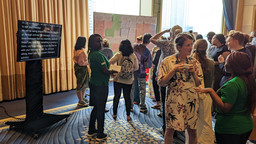
Mobile lectures, a mock newsroom tussle between journalists competing for their editor’s attention, and imagining a day in the life of policymakers and poor farmers were just some of the innovative elements of two workshops on climate change communication run by IIED in Zimbabwe in February 2011.
Development and Climate Days are critical for people interested in learning about the latest in climate change and international development and for building contacts with key policymakers, researchers and negotiators from around the world. Please register to participate in this event.
Negotiators from nearly 200 governments are in Durban, South Africa for crucial talks towards a new global agreement on how to tackle climate change. The fate of the Kyoto protocol – the only agreement that legally binds countries to reduce emissions of greenhouse gases – hangs in the balance, as its first commitment period expires in 2012.
Los miembros latinoamericanos de la la Red Global de Aprendizaje del Programa de Conocimientos HIVOS/IIED/Mainumy Ñakurutú, ‘Productores de pequeña escala como actores en el mercado globalizado’ se reunieron en Lima del 12 al 16 de setiembre pasados. Junto con varias organizaciones prestigiosa organizaron y participaron en una serie de reuniones y eventos.
The Latin American Learning Network members of the Knowledge Programme ‘Small producer agency in the globalised market’ convened in Lima from 12 to 16 September. They organised and participated in a series of meetings and events in conjunction with various prestigious organisations. The highlight of the programme was the International Forum ‘Small-scale producers: Actors in Globalised Markets and Food Security?’ on 14 September, organised by the Pontifical Catholic University of Peru.
Every month we highlight a new, groundbreaking or bestselling IIED research outcome. This month we look at the uncertain future of bioenergy.
The promise of clean, renewable energy makes it a tempting choice but the real costs and benefits are not so simple to calculate. As some talk about a global energy revolution, whilst others start pointing to land grabs, food security issues and a dangerous offsetting tendency in the global North, IIED have started looking into the urgent and critical questions surrounding the debate.
The aim of this action research is to identify and support processes that can help democratise the governance of food systems, land use and the environment. It seeks to find more equitable ways of including citizens in policy making and in the design of technologies and institutions that shape food systems and the environment.
We're pleased to announce that Ripples, a film about climate change and disaster management in Bangladesh, by Soren Vestergaard Neilsen, for RDRS Bangladesh was the winner of our Development and Climate film competition.
Could the informal economy be the route to deliver the big sustainable development ideals such as the Green Economy, Millennium Development Goals and poverty reduction strategies, given that its share is rapidly increasing and that the poor mostly operate here?
This project explores pilot economic research to support climate change adaptation in the water sector of developing countries. It also aims to build the capacity of developing country economists to contribute to action research.
REDD could play an important role in biodiversity conservation. This project aims to identify and test possible mechanisms to help promote high biodiversity REDD.
At the latest provocation from IIED and Hivos, held in Brussels last week (22 June), a group of around 60 policymakers, academics and development practitioners gathered to discuss, among other things, the role of CSR in achieving development goals such as poverty reduction and the empowerment of small-scale farmers.